7 Essential Elements of a Successful SEO Marketing Campaign in 2026
You can't deny that SEO is the most effective marketing technique for reaching the right audience. There's no denying that SEO is the best marketing strategy to hit the right target audience.
SEO 2026 isn't only about integrating keywords into web pages and creating backlinks. Search has evolved and users are finding businesses in both traditional search results and AI-driven experience modes like AI Overviews and AI Mode.
In the business world, it requires a solid technical base, quality content, user intent, authority, and ongoing monitoring to achieve a successful SEO marketing campaign.
Modern SEO should have just one goal – to make your website truly useful, trustworthy, and easy for users and search engines to understand at Hash Digitech, we believe in that.
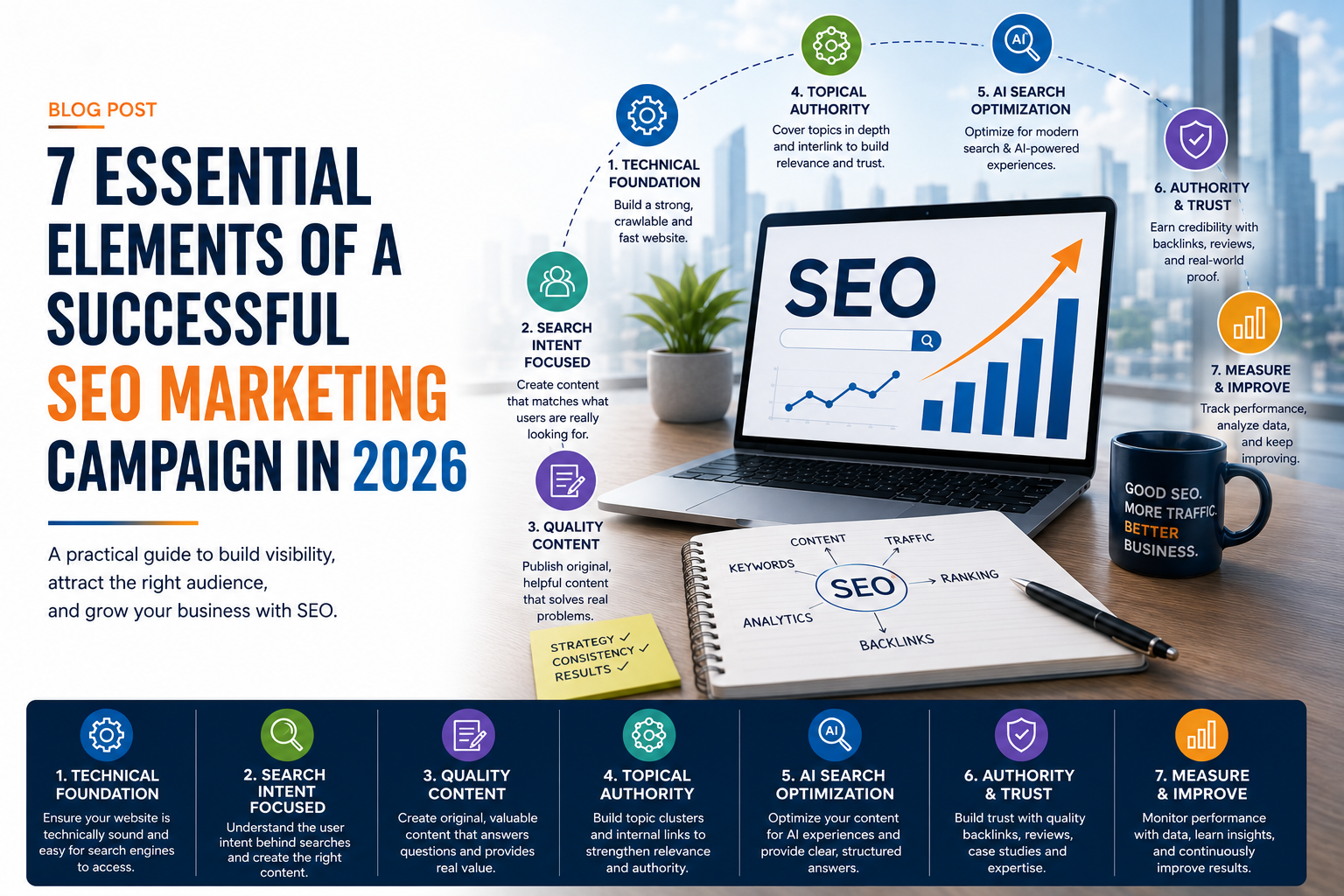
Below are 7 crucial components for a successful SEO campaign in 2026.
1. You must lay a solid foundation with regard to technical SEO.First, you need to build a strong technical foundation.
Prior to investing a lot of money in content or back links, ensure that search engines can access and comprehend your website.
Here are some of the key elements that should be explored during a technical SEO audit:
The ability to crawl and be indexed by web crawlers.
· Page speed and Core Web Vitals
· Mobile usability
· The security of the website and HTTPS
· HTTPS and website security.
· XML sitemap
· Robots.txt
· Canonical URLs
· Internal linking
· No redirect links or broken links.
· Duplicate content
· Structured data
While technical SEO might not ensure top rankings, it sets the stage for your content to be found, crawled, indexed, and understood.
This is increasingly relevant now as AI-driven search experiences are increasingly using content in the search index. Google says in order for pages to be eligible for AI features like AI Overviews and AI Mode, they must have normal technical requirements for Search.
2. Design Your Strategy For Search Intent
A major error that companies make is selecting keywords simply due to the fact that they have a large quantity of key words on the search engine.
Rather, one should ask:
What does the user want to do with the search?
Someone looking for:
You need to use a SEO company in India.
may be looking for an SEO agency.
Someone searching for:
“how does SEO work”
Probably seeking 'educational' information.
And someone searching for:
“SEO services price in India”
may already be shopping around for providers.
It's important these users do not necessarily end up on the same page, as they have different needs.
The successful SEO campaigns of 2026 will involve connecting words with intent, user issues, funnel phases, and suitable content types.
3. Producing content that is Original and People-First.
If you're writing hundreds of articles about generic things, it's not a sustainable strategy to get SEO.
Google's current guidance focuses on content that is helpful, reliable and people focused while discouraging the creation of content to game the search rankings.
Rather, produce content that offers users something that they will not be able to readily find elsewhere on the ten other websites.
That could include:
· Original research
· First-hand experience
· Case studies
· Expert opinions
· Unique examples
· Data and statistics
· Detailed comparisons
· Practical tutorials
· Original pictures or videos
For instance, rather than writing a generic essay titled “What Is SEO?”, a more compelling piece of copy would be one that demonstrates a real business improved its organic search results, the steps it took to improve, what went wrong and the outcomes.
It's not about publishing more.
The aim is to get something read.
4. Strengthen Topical Authority
Getting ranked for just one keyword isn't the only goal anymore.
It is advisable to create a chain of content that is material related to the core competencies of the business.
Let's assume that you sell SEO services to other companies.
You can create topic clusters around:
· Technical SEO
· Local SEO
· On-page SEO
· E-commerce SEO
· Keyword research
· Content strategy
· Link building
· SEO analytics
· AI search
· Google Search Console
Finally, link related pages with relevant internal links.
This can help to organize the site and guide visitors through the content in a logical manner.
The end result is a site that shows depth instead of just targeting individual keywords.
5. Improve for Modern Search and AI Experiences
A powered search is transforming the way people find information, but this doesn't mean you no longer need to perform standard search engine optimization.
Google's 2026 guidance explicitly states that SEO is relevant to generative AI search, explaining that the experiences run on Google's Search and quality systems.
Rather than following each new “GEO trick,” concentrate on the basics:
· Optimize the content of the important page so that search engines can access it.
· Answer questions clearly.
· Use descriptive headings.
· Provide useful supporting information.
· Maintain the accuracy of structured data.
· Build genuine authority.
· Create original content.
· Make your website easy to navigate.
There is no special AI-specific file or schema markup needed to be included to show up in Google's AI features.
So, if you want to have good AI-search visibility, you still need to have good SEO.
6. Establish Trust and Authority. Create Real Trust and Real Authority.
Creating content isn't enough, especially in competitive industries.
You need to provide your website visitors with some justification to trust your business.
This may involve:
· Customer reviews
· Testimonials
· Case studies
· Author information
· Industry certifications
· Client results
· Expert contributors
· Transparent company information
· High-quality external references
When you are in a service business, avoid stating:
We offer the highest Quality SEO Services.
Show evidence.
Tell them what you do, show them your knowledge, share your results if applicable and make it simple for the prospective client to see that they can trust you.
The authority is to be earned, not constructed.
7. Measure, learn and continually improve
SEO is not a one-time effort.
It's important to continuously analyse a successful SEO strategy.
Track indicators like:
· Organic clicks
· Impressions
· Rankings
· Click-through rate
· Organic conversions
· Leads
· Engagement
· Indexed pages
· Technical errors
· Top-performing content
· Underperforming pages
Google Search Console is especially helpful to gain insights into how your website is performing on Google Search. Google has also started rolling out a specific performance reporting section for the generative AI in Search Console, giving visibility to impressions of generative AI features.
It's not about rankings per se.
It's helpful if a keyword comes up from #20 to #10, but if it doesn't bring in any traffic or conversions, then it might not be worth much in terms of business.
The big question should be:
Is the business meeting its objectives due to SEO?
The Future of SEO Is Quality + Relevance + Trust
SEO in 2026 is no longer about optimizing for the individual ranking signals; it's about creating a website that is worthy of being found.
A powerful SEO marketing campaign blends:
Technical SEO, Search Intent, Helpful Content, Topical Authority, AI Search Readiness, Trust, Continuous Optimization
No shortcut to ranking.
Rather, companies that continuously produce valuable content, have a technically viable web, understand their audience and establish real authority are more likely to be successful in both traditional search and future AI-powered search.
Here at Hash Digitech, we work with businesses to build SEO strategies that focus on sustainable, long-term results for organic visibility, not just quick rankings.
When it comes to preparing your business for a more robust SEO presence in 2026, the first step is to audit your existing SEO foundation, and assess which areas are ripe for improvement.